

From Acquisition to Integration: Scaling UpNest Across Realtor.com
How I led design through an acquisition and turned a single page integration into one of the highest-performing features.
Realtor.com had just acquired UpNest, but the only connection between the two products was a handful of low-visibility links and buttons — and the UpNest lead flow itself buried agents behind a multi-step questionnaire before showing a single one.
Product Designer, first at UpNest and then inside Realtor.com after the acquisition. I led the integration design across three iterations and its rollout to additional surfaces.
A flipped lead flow that shows real agent profiles before asking for any personal information, iterated across three versions and expanded to placements across search results, editorial content, and a dedicated landing page.
277% increase in lead volume at V1 launch, plus a further 73% and 23% lift in submission rate across V2 and V3 — becoming one of the top lead sources across both UpNest and Realtor.com.
Background
When Realtor.com acquired UpNest in 2022, I was already on the inside.
UpNest is a service that connects home sellers with agents who compete for their business through personalized proposals. I had been the lead designer at UpNest for the two years prior, and when the acquisition happened I joined the Realtor.com team to continue working on UpNest and support the integration.
Realtor.com was where people went to find a home. Helping them sell one was a different story. The challenge wasn't just technical; it was strategic: how do you surface a newly acquired service to millions of existing Realtor.com users without disrupting an experience people already trusted?
The Opportunity
Realtor.com's off-market property detail pages attracted a specific, high-intent audience: homeowners. People who landed on these pages were often looking at their own home's estimated value, its square footage, its last sale price, quietly asking themselves what it would take to sell.
The existing experience didn't meet them there. Before this project, the only connection between Realtor.com and UpNest was a handful of links and buttons scattered across the platform: low-visibility entry points that required users to seek out the service rather than encounter it naturally.
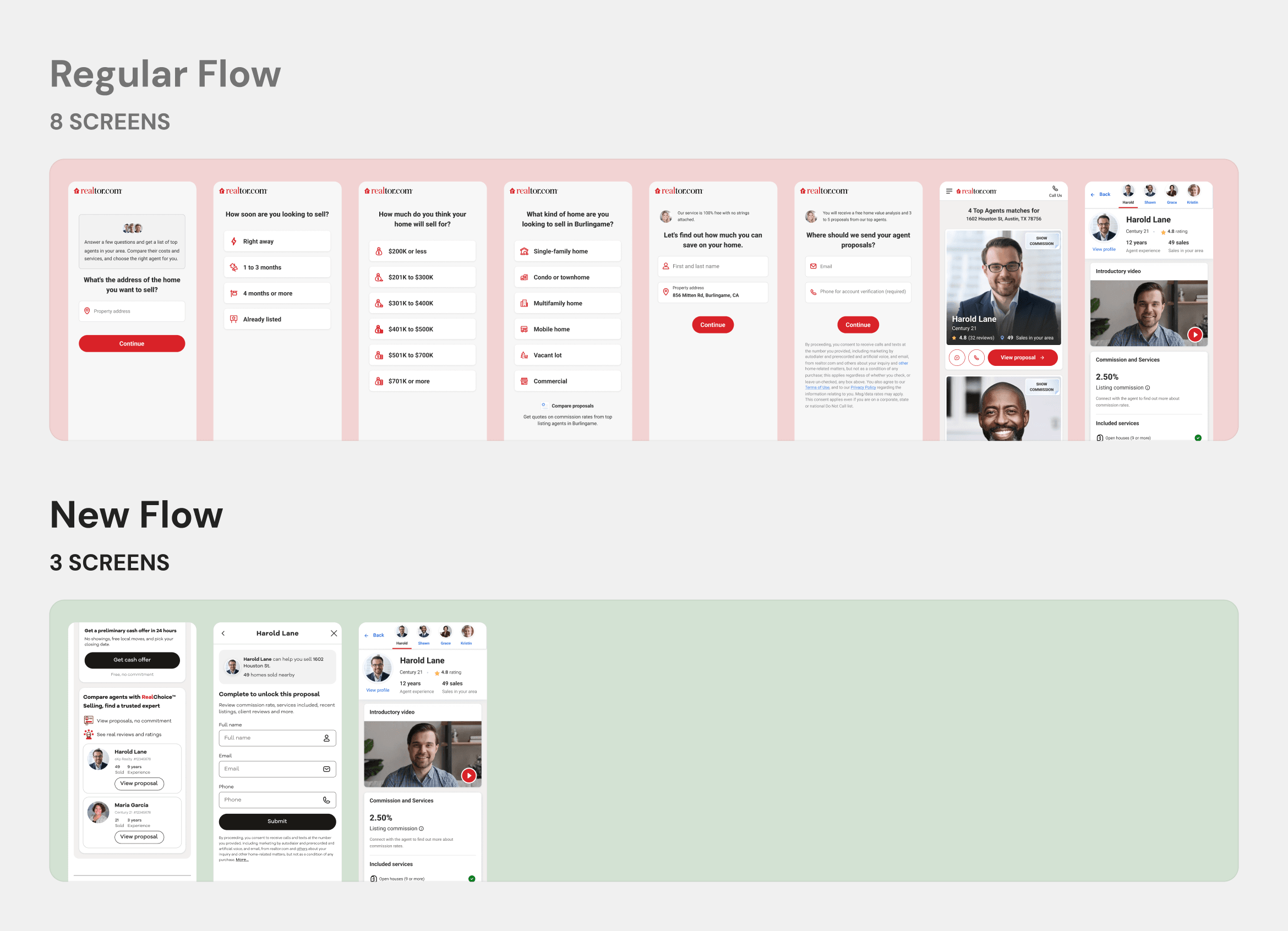
Worse, the traditional UpNest lead flow made users complete a multi-step questionnaire before seeing a single agent: address, estimated home value, selling timeline, name, email, phone. On a page where we already knew the address and could pull home value data from MLS sources, that form was unnecessary friction standing between a high-intent user and a relevant recommendation.
The Insight
Flip the flow. Show agents before asking for anything.
The core strategic decision was to flip the flow entirely. Rather than making users earn the right to see agents by filling out a form, we would show agent profiles immediately, dynamically fetched based on the property address, pulling from agents who had already set up automatic proposals through UpNest's price-tier system. Personal information (name, email, phone) would only be requested when a user actively clicked “View proposal” on a specific agent. A moment of expressed intent, not a toll at the entrance.
The Execution
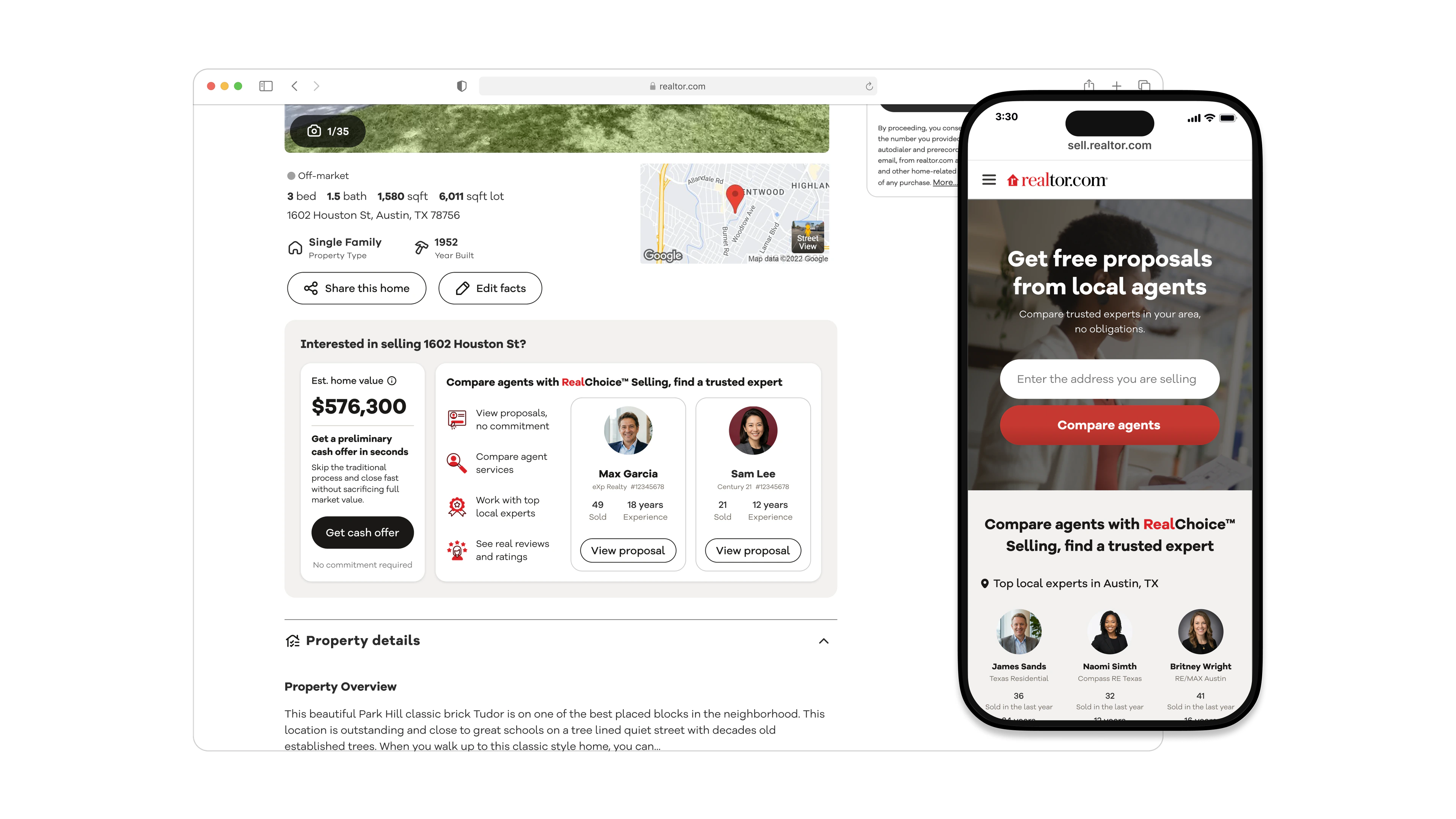
Off-Market Property Page Agent Profiles Module
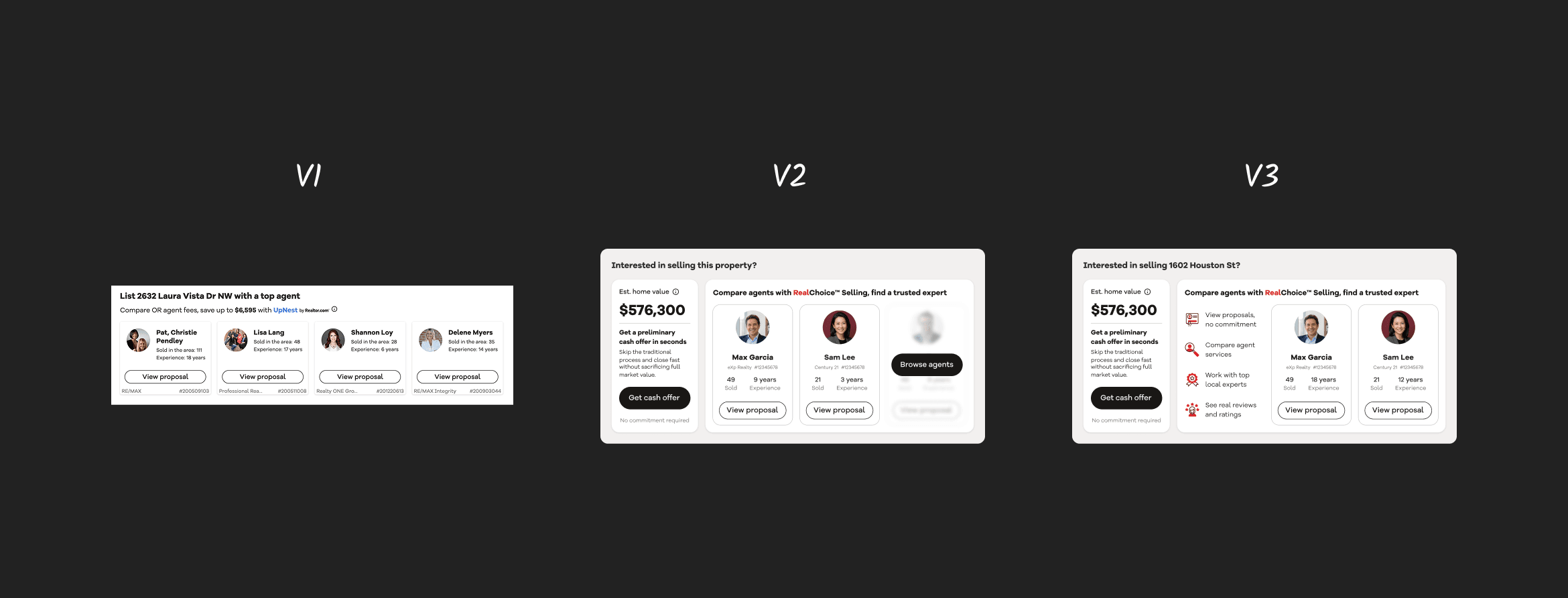
V1 — Proof of concept
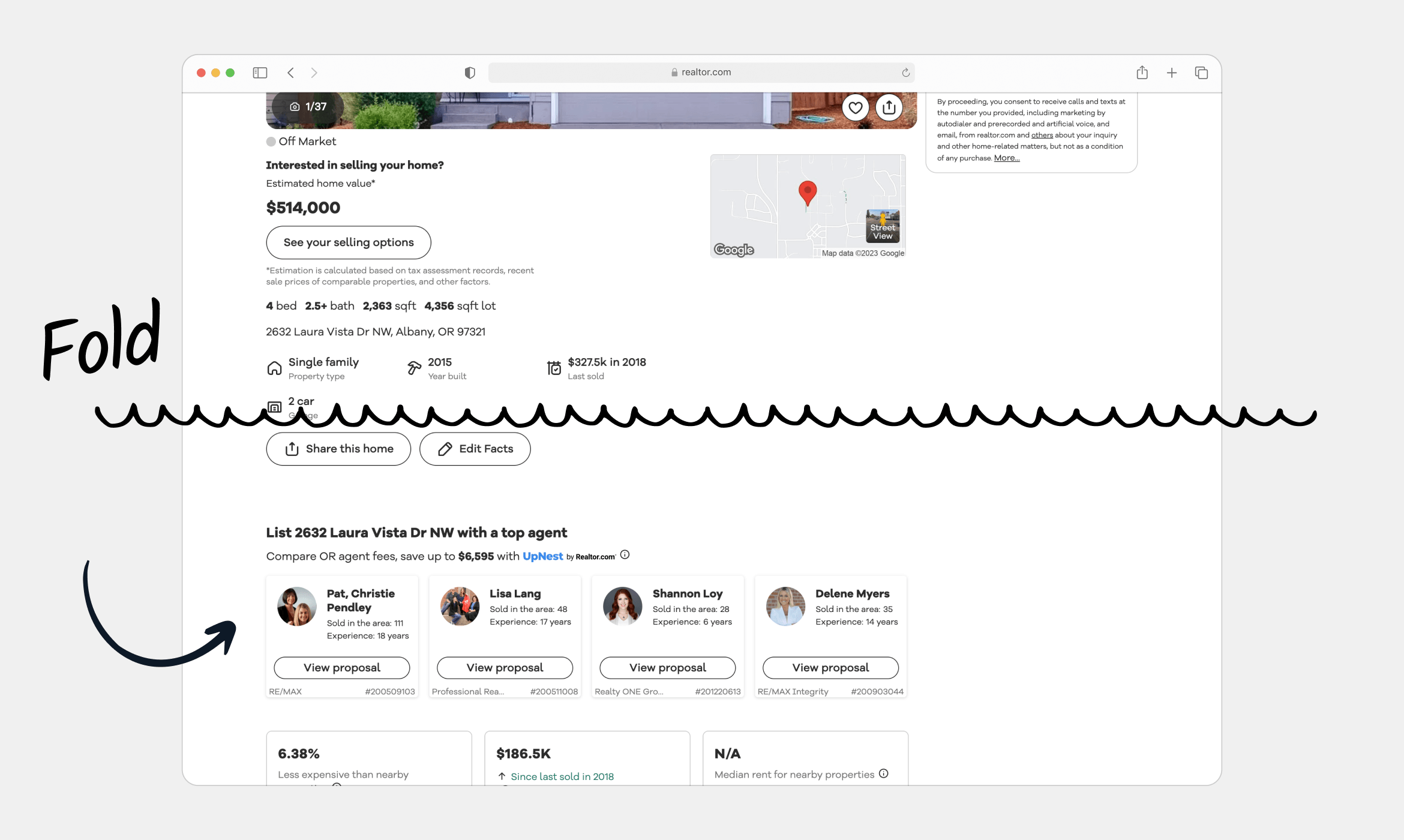
The first version introduced agent profiles to Realtor.com's Off-Market Property Detail Pages for the first time. Real agent data (photo, name, brokerage, local sales count, years of experience) surfaced dynamically based on the property address. It was a significant leap from links and buttons, and the results reflected that immediately.
V2 — Consolidation
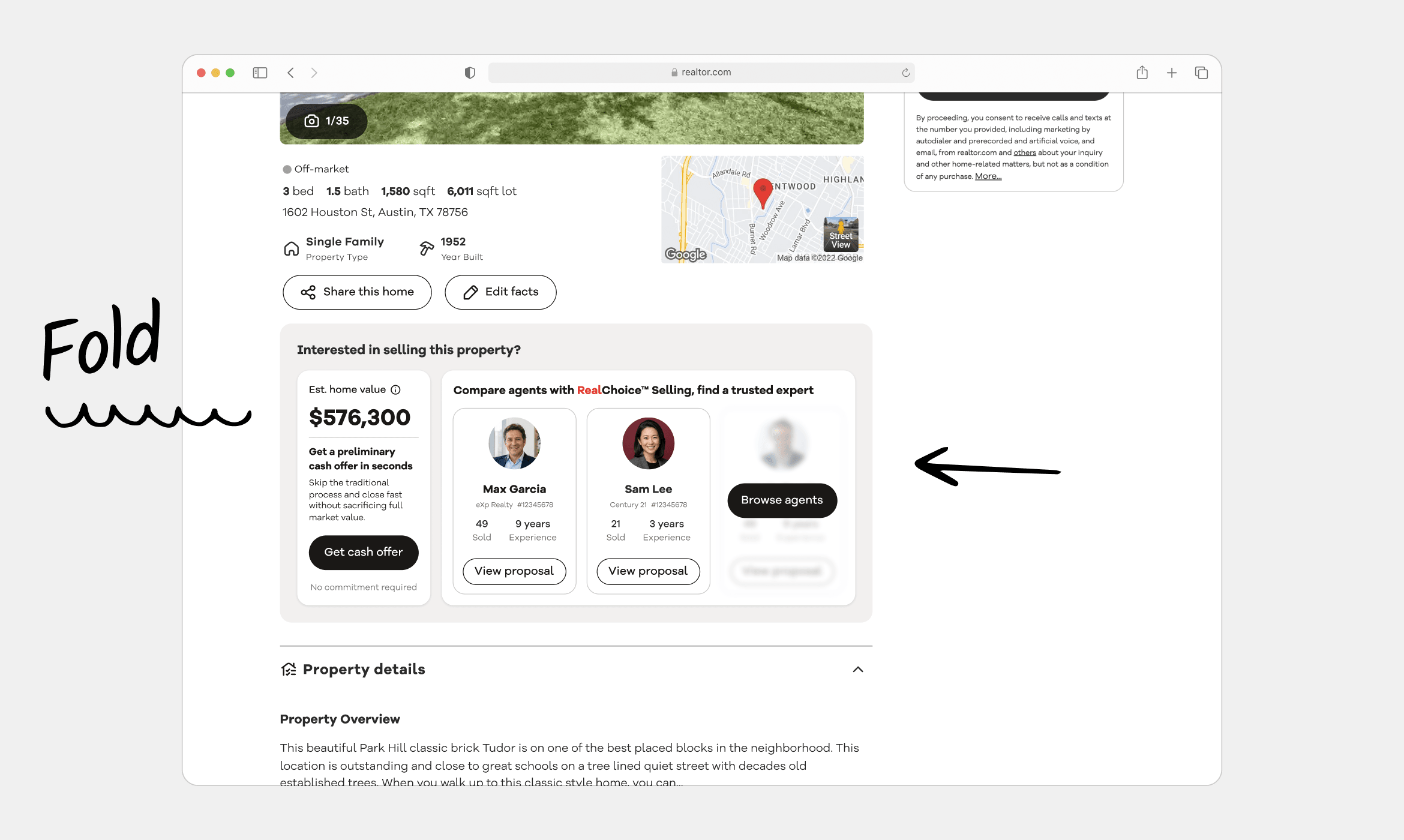
V1 validated that agent profiles worked. But looking at the page holistically, something else became clear: selling options were scattered. Home value estimate in one place, cash offer buried elsewhere, agent cards below the fold. Users had to scroll and piece together their own picture of what selling this home could look like.
V2 addressed this directly. I redesigned the page around a unified selling module, consolidating all selling options in one place and bringing agents above the fold for the first time. A third slot introduced a “Browse agents” button, intended to expand the visible agent pool through a modal.
V2 also marked a branding shift. Realtor.com transitioned these entry points from UpNest to RealChoice Selling, its unified identity for seller services. You'll see that reflected in the designs from here on.
V3 — Refinement through data
Analytics told a clear story: the “Browse agents” button wasn't getting the engagement we expected. Users weren't clicking through to see more agents; they were making decisions based on the two visible profiles already in front of them. Rather than pushing users toward a larger list they weren't asking for, I replaced the third slot with value props reinforcing why they should engage with the agents already visible.
The Impact
277%
Increase in lead volume at V1 launch
+73%
Improvement in lead submission rate
+23%
Further increase in lead submission rate
Became one of the top sources of leads across both UpNest and Realtor.com, and proved a concept that would scale across the entire platform.

“I worked closely with Pedro during the UpNest integration into Realtor.com, where he consistently demonstrated an exceptional ability to translate early-stage ideas into polished, high-impact product experiences. He is fast, thoughtful, and highly effective in navigating ambiguity.
What sets Pedro apart is his ability to bring a startup mindset into a large organization, moving with speed and flexibility while designing solutions that scale. He is a strong collaborator and a true multiplier, elevating both the work and the teams around him.”
Tiana Tam
Senior Product Manager, Realtor.com
Agent Profiles Everywhere
The success of the Off-Market Property Detail Page integration prompted a broader initiative: if agent profiles worked in one high-intent context, where else on Realtor.com could they create value?
I led the design of agent profile placements across three additional surfaces, each requiring the component to adapt to a different context, user intent, and surrounding layout, while keeping the experience consistent and recognizable.
RealChoice Selling Landing Page
Agent profiles integrated directly into the dedicated RealChoice Selling landing page, reinforcing the value proposition with real, local agent data at the very top of the funnel. This placement is live on Realtor.com today.
Search Results Page
Agent cards surfaced inline within property search results, reaching potential sellers earlier in their browsing journey, before they'd landed on any specific property.
News & Insights Articles
A contextual widget embedded within Realtor.com editorial content, connecting readers already engaged with local market data to agents in their area.
Reflection
This project reinforced that starting small is a strategy, not a compromise. Links and buttons first. One page. Measure. Then scale. Every iteration was more informed because the previous one had taught us something we couldn't have predicted in advance, including that users didn't want more agents to browse. They wanted confidence in the ones already in front of them.
It also marked a shift in how I worked. The acquisition took me from being the only designer in the room to being part of an organization with over 50 designers, a design manager, a VP, and a dedicated Design Systems team. It was a different kind of challenge, and a valuable one. Working within a more structured environment taught me things I couldn't have learned on my own.
Other work

NEWMARK • 2025–2026
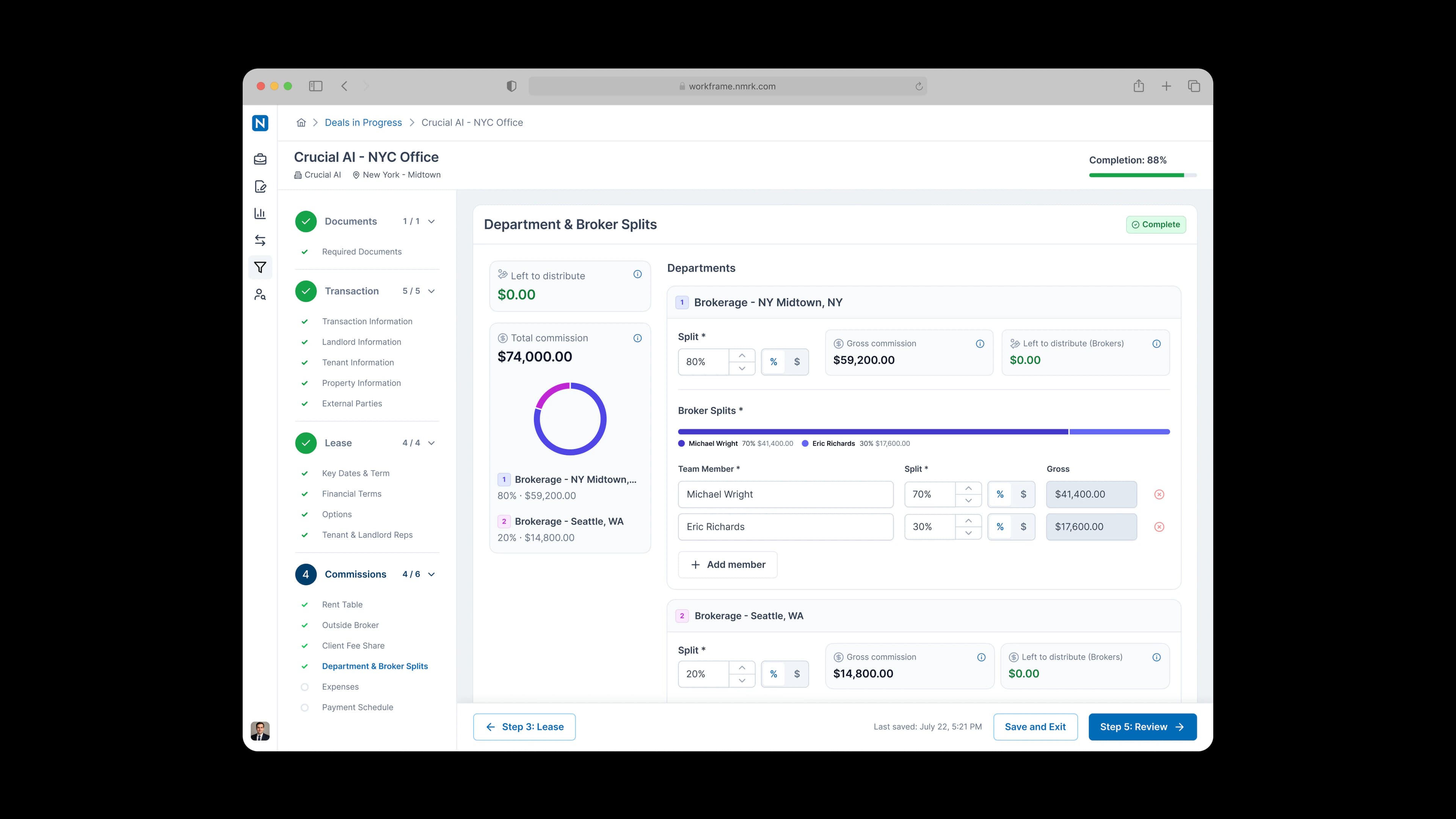
Rebuilding Newmark's Deal Submission Flow
How I redesigned a dreaded legacy form into a guided, self-checking flow.
UPNEST • 2020–2022
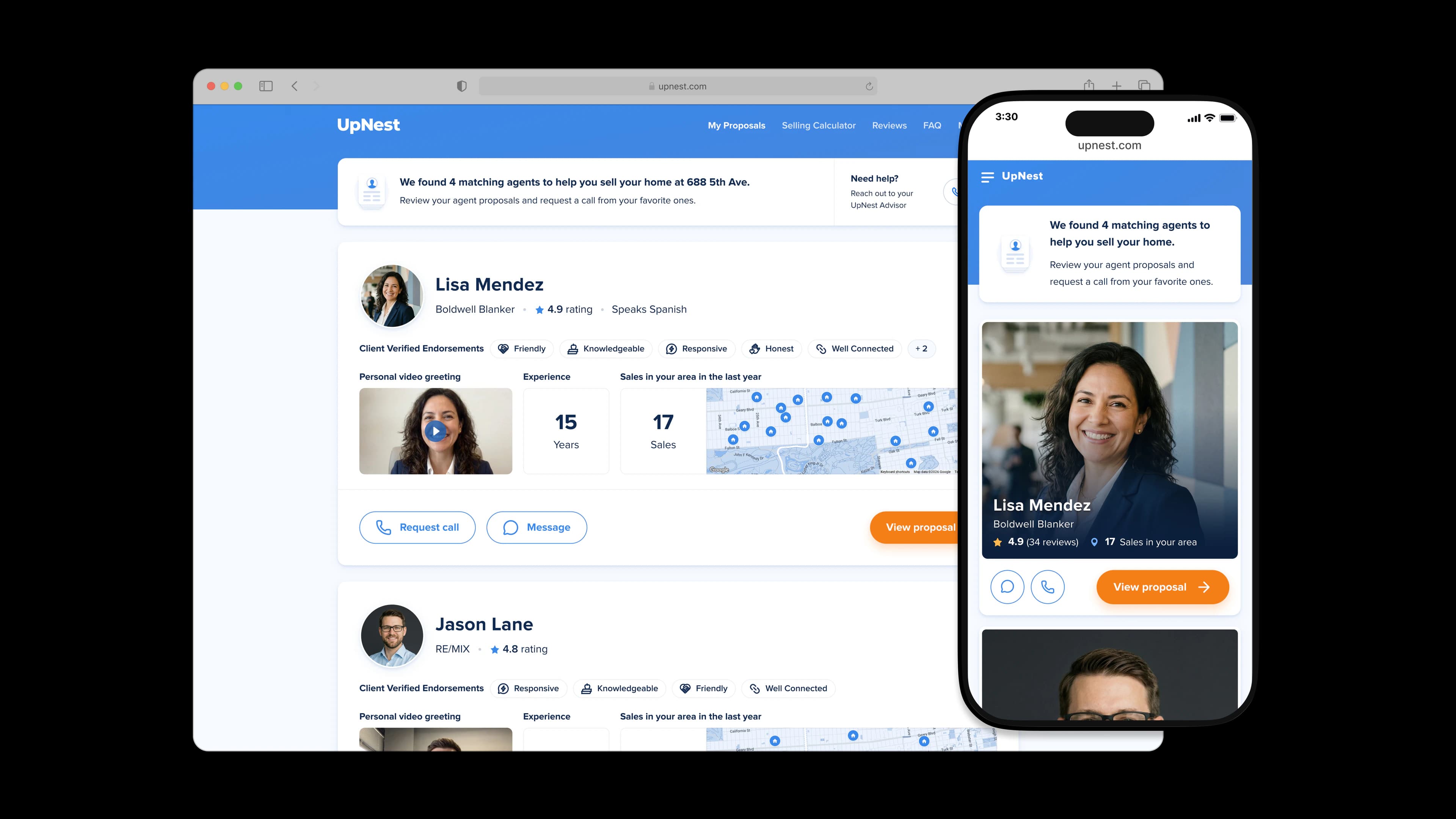
Inside UpNest: The Sole Designer Across a Startup's Entire Product
How I owned the design across the full product and elevated it until acquisition.